










What Are the Top Vape Battery Types for Global Buyers?
Choosing the right battery is a practical safety decision for global vape buyers. Vape Batteries differ in capacity, output stability, charging design, and replacement options. A compact device may use an integrated lithium-ion cell, while larger models can support removable 18650 or 21700 batteries. Each type creates different purchasing and maintenance needs.
Integrated batteries often simplify daily use. They usually include a built-in charging port and device-specific protection system. Removable batteries offer flexibility, but they require compatible chargers, secure storage, and careful handling. Small details matter. A loose battery wrap, an unsuitable charger, or unclear labeling can create avoidable risks. Buyers should check rated capacity, continuous discharge information, temperature protection, and verified manufacturing data.
Global sourcing adds another layer of responsibility. Reliable suppliers should provide traceable specifications and evidence of relevant testing, such as IEC 62133 guidance and UN 38.3 transport documentation. Market requirements may also include CE, UKCA, or other regional conformity marks. These labels deserve verification, not blind trust. Packaging should show the model, voltage range, warnings, and recycling information clearly.
This guide compares common battery types through a buyer’s practical lens. It considers performance, lifespan, portability, supplier reliability, and regional compliance. Some specifications look impressive but lack independent support. That is worth questioning. The best choice is rarely the strongest battery alone; it is the safest, most compatible option for the intended device and market.
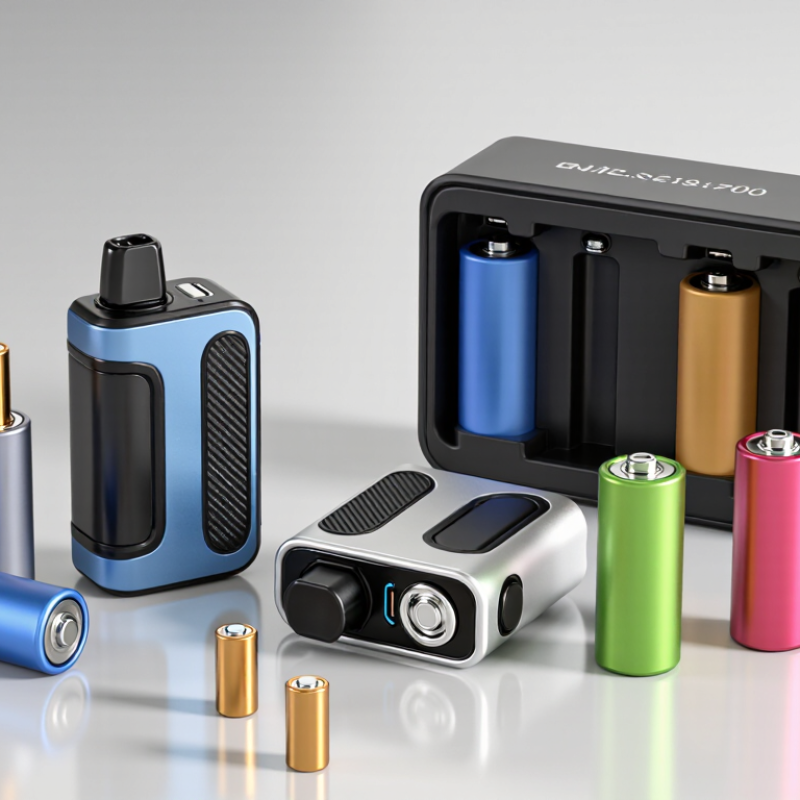
Vape Battery Basics: Role, Design, and Core Performance Factors
Vape battery choice starts with its role: storing energy, delivering current, and supporting stable device operation. Common formats include 18650, 21700, and pouch cells. An 18650 offers compact dimensions and wide availability. A 21700 usually provides higher capacity and longer operating time. Pouch cells support slim designs, but they require careful enclosure and pressure control.
Design affects real performance. Buyers should examine chemistry, rated capacity, continuous discharge current, cycle life, temperature range, and protection features. Peak current claims can look impressive but may not reflect continuous use. The International Energy Agency reported that global electric-vehicle battery demand exceeded 750 GWh in 2023, growing about 40%. This shows the scale of lithium-ion manufacturing, but it does not guarantee every cell suits vaping devices. BloombergNEF reported average lithium-ion pack prices of 115 dollars per kWh in 2024. Lower prices may improve access, yet quality control still matters. I sometimes overvalue capacity figures; a smaller, well-matched cell can perform more reliably.
Tips: Request a current datasheet, batch traceability, and recognized transport test documentation. Check UN 38.3 evidence for shipping and IEC 62133-2 alignment where applicable. Do not mix cells with different ages, capacities, or conditions. A damaged wrapper needs replacement. Small details matter.
| Battery Type | Typical Dimensions | Common Nominal Voltage | Typical Capacity Range | Discharge Capability | Primary Strength | Typical Application | Key Buyer Considerations |
|---|---|---|---|---|---|---|---|
| 18650 Cylindrical Li-ion | Approximately 18 mm diameter × 65 mm length | 3.6–3.7 V; 4.2 V when fully charged | Approximately 2,000–3,500 mAh | Varies widely by cell design; high-drain versions are commonly selected for power devices | Compact size, broad availability, and a large range of capacity and discharge options | Single- or multi-cell removable-battery devices | Use only cells with verified specifications; capacity and maximum continuous discharge rating should match the device requirements |
| 21700 Cylindrical Li-ion | Approximately 21 mm diameter × 70 mm length | 3.6–3.7 V; 4.2 V when fully charged | Approximately 3,000–5,000 mAh | Often supports strong continuous-current performance, depending on the specific cell | Higher energy storage and potentially longer runtime than many 18650 cells | Higher-power removable-battery devices designed for the larger format | Confirm compartment dimensions, battery wrap condition, charger compatibility, and device current limits |
| 20700 Cylindrical Li-ion | Approximately 20 mm diameter × 70 mm length | 3.6–3.7 V; 4.2 V when fully charged | Approximately 2,800–4,000 mAh | Usually positioned between standard-capacity and high-drain options, depending on construction | Offers a balance between compactness, capacity, and current delivery | Devices specifically designed for 20700 cells or compatible larger battery formats | Less interchangeable than 18650; buyers should verify exact fit and electrical compatibility before purchase |
| Built-in Li-ion Battery Pack | Custom dimensions determined by the device enclosure | Usually based on 3.6–3.7 V cells; regulated by an integrated control circuit | Commonly approximately 500–5,000 mAh, depending on device size | Managed by the device's protection and power-control system | Convenient operation, integrated charging, and no need to handle loose cells | Compact pod systems, regulated devices, and rechargeable electronic products | Evaluate charging speed, battery-serviceability, cycle life, protection functions, and replacement policy |
| Lithium-polymer (LiPo) Pouch Pack | Flexible flat-pack dimensions; custom thickness, width, and length | Typically 3.7 V nominal per cell; 4.2 V when fully charged | Approximately 300–3,000+ mAh, depending on pack size | Can provide high current in a compact package when correctly designed | Flexible shape, efficient use of internal space, and high power-to-weight potential | Custom-built devices and products using an integrated battery pack | Requires robust mechanical protection, accurate charging control, insulation, and protection against puncture or swelling |
| Protected Cylindrical Cell | Usually slightly longer than the underlying 18650, 20700, or 21700 cell | Generally 3.6–3.7 V nominal; protection circuit limits unsafe conditions | Usually lower than an equivalent unprotected cell because of the added protection circuit | Often lower than high-drain unprotected cells because the protection circuit may limit current | Added protection against overcharge, over-discharge, and short-circuit conditions | Low- to moderate-power devices designed to accept protected cells | Check the device's physical clearance and current demand; protection circuits do not replace safe handling |
| Unprotected High-drain Cell | Commonly available in 18650, 20700, and 21700 formats | 3.6–3.7 V nominal; 4.2 V when fully charged | Capacity depends on the required current performance; higher-current cells may have lower capacity | Designed for demanding loads, subject to the cell's verified continuous-discharge specification | Efficient current delivery for regulated high-power applications | Devices with built-in electronic protections and clearly specified battery requirements | Requires careful inspection, correct charging, undamaged wraps, and strict adherence to the device's battery limits |
Safety and purchasing note: Lithium-ion batteries must be selected according to the device manufacturer's voltage, current, size, and charging requirements. Do not use cells with damaged wraps, mix cells with different ages or specifications in multi-cell devices, carry loose cells with metal objects, or charge unattended. Capacity and discharge figures vary by cell design, temperature, testing method, and operating conditions.
