















What Are the Top Types of IQ Modulators?
An IQ Modulator turns electrical I and Q signals into controlled changes in an optical carrier’s amplitude and phase. That control enables advanced formats used in coherent fiber links. The choice is practical: architecture, bandwidth, insertion loss, drive voltage, and integration needs all matter.
Cisco’s Annual Internet Report, 2018–2023, forecast global IP traffic would reach 396 exabytes per month by 2022, up from 122 exabytes in 2017. That forecast is not a measure of modulator sales. It does show why optical networks need capacity and efficient signal transmission. As communications theorist Claude Shannon wrote, “The fundamental problem of communication is that of reproducing at one point either exactly or approximately a message selected at another point.” His work informs the communication principles behind modern modulation.
Small differences matter. This guide compares single-drive, dual-drive, and nested dual-parallel designs, then considers material platforms such as lithium niobate, indium phosphide, and silicon photonics. Each brings trade-offs; no design wins in every application. A compact package may ease system integration, while a particular voltage or bandwidth may better suit a transmitter’s electronics.
Specifications also need context. Test conditions, wavelength, and frequency response can change how headline figures translate into real performance. The sections ahead explain what distinguishes the main IQ Modulator types, where each is commonly used, and which details deserve closer scrutiny before selection.
Mach–Zehnder-Based IQ Modulators
What Are the Top Types of IQ Modulators?
Mach–Zehnder-Based IQ Modulators
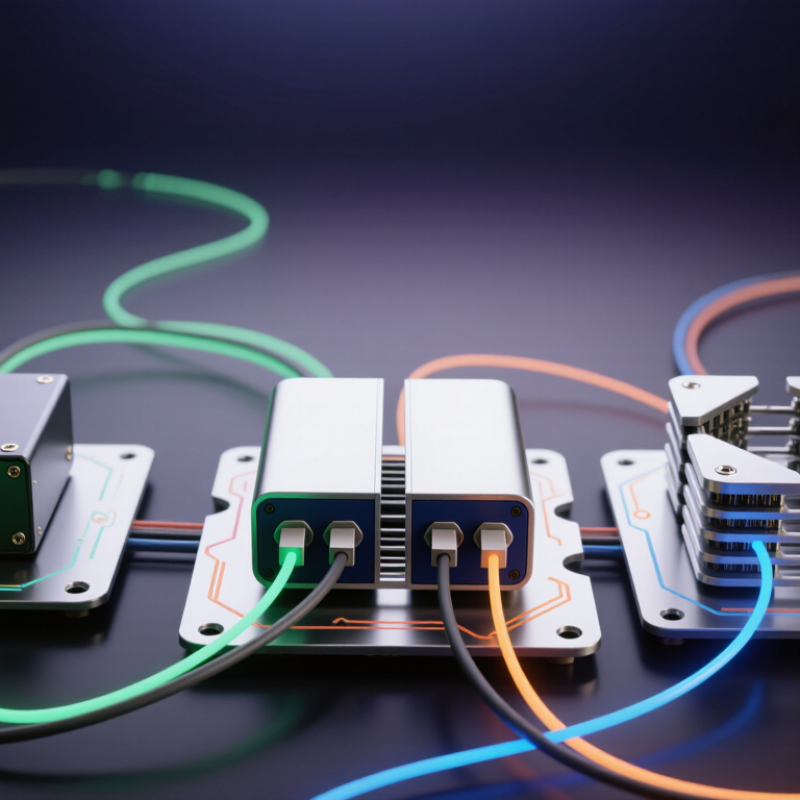
A Mach–Zehnder-based IQ modulator uses two smaller interferometers, one for the in-phase (I) signal and one for the quadrature (Q) signal. Their optical outputs are combined with a relative phase shift of about 90 degrees. This arrangement lets the device control both the amplitude and phase of an optical carrier, which is useful in coherent communication systems.
The layout is elegant. The real hardware is less tidy. Electrodes apply fast electrical signals to each path, changing its refractive index and shifting the light’s phase. By coordinating the I and Q drives, the modulator creates complex signal formats without switching the laser itself. A practical detail matters: each Mach–Zehnder section has a bias point that must be set accurately. Temperature changes can shift it, so some systems use feedback to keep operation stable. Misalignment can distort the constellation, even when the drive signals look correct.
Design choices affect performance. Electrode geometry influences bandwidth, while optical losses reduce the power reaching the receiver. A nested design can support low-chirp operation under suitable conditions, but it does not make every implementation immune to distortion. Engineers therefore check bias stability, drive voltage, insertion loss, and linearity together—not as isolated specifications.
